
OT Consortia
An OT Consortium is a relationship between a government sponsor and a collection of traditional and non-traditional vendors, non-profit organizations, and academia aligned to a technology domain area (i.e., cyber, space, undersea, propulsion) that are managed by a single entity, and focused on innovative solutions to government technology challenges that meet the intended scope and purpose of other transactions.
OT Consortium Model
An OT Consortium generally have 3 components, although some government sponsors opt to manage a consortium in house rather than hire an industry Consortium Manager or Consortium Management Firm. The Consortium Manager is awarded an OT agreement by the government (base OT agreement) and manages OTs awarded to its consortium member organizations (project OT agreements) under the base agreement.
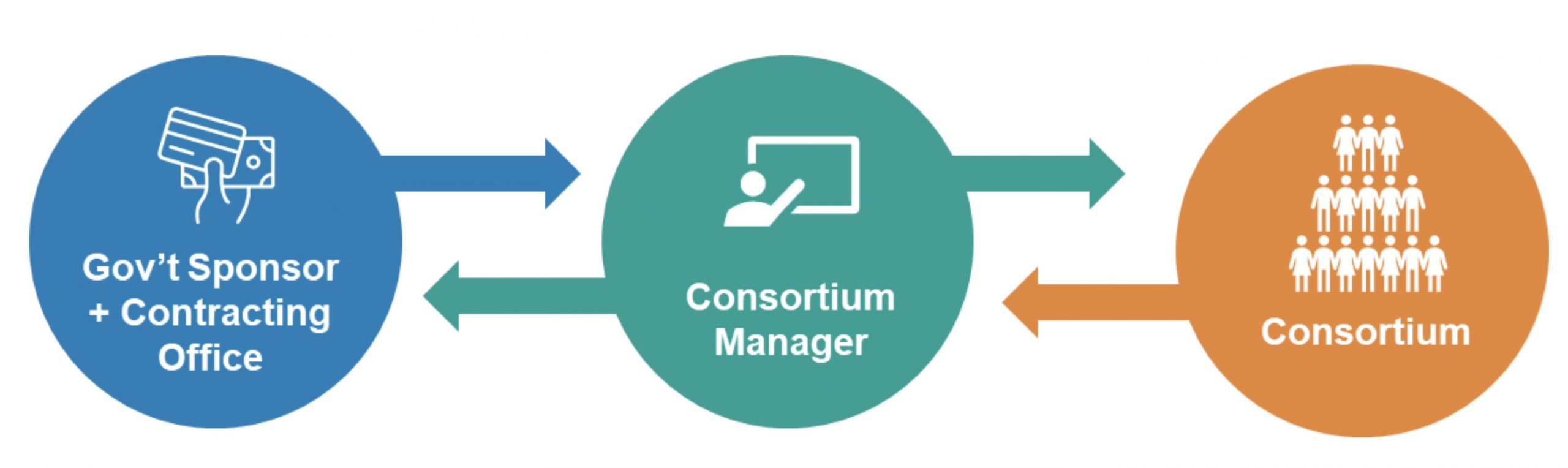
- Award an Other Transaction (OT) agreement to a Consortium Manager to handle administrative processes and workload for a specific technology domain
- Establish consortium objectives and overarching execution guidelines
- Select projects for consortium award based on alignment with objectives and suitability for OT
- Approve evaluation criteria and project OT award selections
- Establish processes for consortium applications, membership terms, and collection of fees/dues*
- Execute member agreements with each consortium organization
- Collect a percentage fee for each project OT awarded under the base OT agreement*
- With the government sponsor, support development of problem statements, white paper/RFPP content, selection phases, and evaluation criteria
- Communicate white paper/RFPP requests to consortium members (often via internal portal)
- Facilitate demos and communications between members and government; support demo evaluation and down-selects
- Manage proposal evaluations, project OT award selections, negotiations, and cost analysis (subject to government approval)
- Manage post-award administration (deliverables monitoring, invoice/payment tracking, reporting) on behalf of the government customer
- Maintain a library of unfunded proposals for potential future use by current or new government customers
- Membership fess/dues and award fee percentages vary by consortium, see Existing OT Consortia page for details.
- Established to support a specific technology domain (e.g., cyber, space, undersea, propulsion)
- Membership open to qualifying U.S. entities (traditional/non-traditional contractors, non-profits, academia); some consortia allow foreign entities
- Entities may join one or multiple consortia
- Members are subject to membership terms (often annual fees and a fixed-percentage fee on each project OT award)
- Members gain access to government requests for white papers and prototype proposals specific to the consortium
- Consortium managers may facilitate member partnering; members may team to propose solutions
- Traditional contractors must be prepared to meet OT cost-sharing requirements
- Members may negotiate unique terms and conditions for individual projects
- Awarded members pay a percentage fee to the consortium manager per project OT, per consortium terms
Consortium Pros
A pool of vendors aligned to consortium focus area (i.e., cyber, space, undersea, propulsion) promotes an environment for collaboration with the government and with other consortium members.
Consortia execute OT agreements which allow for a more collaborative process than traditional FAR processes that are bound by rigid source selection statutes and regulations.
Consortia have established streamlined processes that quickly move through white papers, demos, proposals, evaluations, and selections and often execute awards more quickly than traditional government acquisition programs.
Consortium Cons
Non-traditional vendors, non-profit organizations, and academic organizations may be challenged by the financial considerations of consortia membership due to fees and % of award fees charged by consortia.
Some consortia are in high demand by government customers and are thereby resource constrained. This can due to volume of work for the consortium or by the availability of the assigned government contracting office.
Many consortia do not award follow-on production activities.

Questions to Ask when Shaping an OT Strategy
- Does the agency currently have Congressional authorization for OTs?
- Will the organization’s approval authorities grant permission to use an OT? What additional information is necessary to gain their approval?
- How will the funding arrangements work (timing, amounts, color of money, etc.)? When are funds available?
- Does the organization have experience with OTs and a warranted Agreements Officer?